
Running a snacks or bakery production line is not just about making good products. It’s about moving those products safely, quickly, and consistently from one stage to the next—without damage, delays, or contamination.
That’s where the right conveyor system makes a real difference.
At Eti Automation, we’ve worked closely with food manufacturers across India. From small bakeries scaling up production to large FMCG plants running 24/7, we’ve seen what works—and what causes problems. This page is designed to give you clear, practical guidance so you can make the right decisions for your facility.
Why Conveyor Systems Matter in Food Processing
In snacks and bakery production, products are often:
- Fragile (biscuits, chips, wafers)
- Sticky or oily (namkeen, sweets)
- Sensitive to contamination (packaged foods)
- Produced at high speed
Manual handling simply can’t keep up with modern demand. It also increases the risk of:
- Product breakage
- Hygiene issues
- Inconsistent flow
- Higher labor costs
A well-designed conveyor system solves these challenges by creating a smooth, controlled movement across your entire production line.
Understanding Food Conveyor Requirements
Food processing conveyors are not the same as general industrial conveyors. They must meet specific requirements:
1. Hygiene and Cleanability
Food-grade conveyors must be easy to clean and resistant to bacteria buildup.
What this means in practice:
- Smooth surfaces with no sharp edges
- Minimal joints where dust or crumbs can collect
- Washdown-compatible materials
2. Gentle Product Handling
Snacks and baked goods are easily damaged.
For example:
- Potato chips can break due to sudden drops
- Biscuits can crack due to vibration
- Cakes can deform under pressure
A good conveyor system reduces impact, vibration, and unnecessary handling.
3. Speed Control and Synchronization
Different processes run at different speeds—mixing, baking, cooling, packaging.
Conveyors help balance this flow by:
- Acting as buffers
- Matching machine speeds
- Preventing bottlenecks
4. Food Safety Compliance
Depending on your market, your system may need to align with:
- FSSAI guidelines (India)
- HACCP practices
- International standards for exports
Types of Conveyor Systems Used in Snacks & Bakery Lines
Choosing the right conveyor depends on your product, layout, and production goals. Here are the most commonly used systems:
Belt Conveyors (Food Grade)
These are the most widely used conveyors in food processing.
Best for:
- Biscuits, cookies, bread
- Cakes and pastries
- Packaged food items
Why they work:
- Smooth movement reduces product damage
- Easy to clean and maintain
- Suitable for incline and decline movement
Practical tip:
If you handle oily snacks like namkeen, choose belts that resist oil absorption and are easy to wash.
Modular Plastic Conveyors
These conveyors use interlocking plastic modules instead of a continuous belt.
Best for:
- Wet or washdown environments
- Meat and processed food lines
- Areas needing frequent cleaning
Advantages:
- Durable and long-lasting
- Easy to replace damaged sections
- Better airflow (useful for cooling)
Wire Mesh Conveyors
Often used in high-temperature processes.
Best for:
- Baking ovens
- Frying lines
- Cooling tunnels
Why they’re useful:
- Heat-resistant
- Allow air circulation
- Ideal for uniform baking or cooling
Roller Conveyors
Typically Roller Conveyors used for secondary packaging.
Best for:
- Cartons
- Boxes
- Bulk packaged goods
Benefits:
- Cost-effective
- Simple design
- Ideal for warehouse movement
Incline and Z-Type Conveyors
Used to move products vertically between different levels.
Best for:
- Feeding packaging machines
- Moving products from fryer to seasoning
- Elevating products to storage bins
Example:
In a chips manufacturing line, a Z-type conveyor can lift chips from the fryer to the seasoning drum without manual handling.
Key Applications in Snacks & Bakery Lines
Let’s look at how conveyors are used in real production environments.
1. Dough Handling
In bakeries, dough needs to move between:
- Mixing
- Dividing
- Shaping
Challenge: Dough is sticky and can deform easily.
Solution:
Use non-stick belt conveyors with controlled speed to avoid stretching or tearing.
2. Baking and Frying
Products pass through ovens or fryers.
Requirement:
- Heat-resistant conveyors
- Consistent speed for uniform cooking
Example:
Wire mesh conveyors are commonly used inside ovens to ensure even heat distribution.
3. Cooling Lines
After baking or frying, products must cool before packaging.
Why this matters:
- Packaging hot products can cause moisture buildup
- It affects shelf life
Solution:
Long cooling conveyors or spiral conveyors that allow enough time for natural cooling.
4. Inspection and Sorting
Products are checked for quality before packaging.
Typical setup:
- Slow-moving belt conveyors
- Adequate lighting
- Space for manual inspection or sensors
5. Packaging Integration
This is where conveyors directly impact efficiency.
They help:
- Feed products into packaging machines
- Align products correctly
- Maintain consistent spacing
Example:
A biscuit line may use multiple conveyors to align rows before entering a flow wrap machine.
6. Finished Goods Handling
Once packed, products need to move to storage.
Used systems:
- Roller conveyors
- Incline conveyors
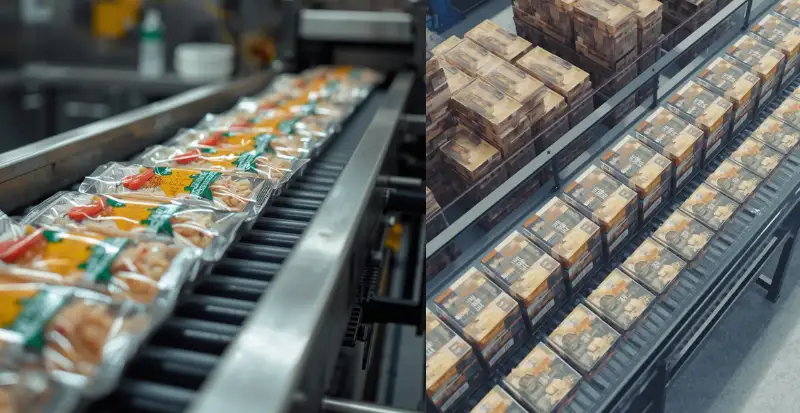
- Sorting conveyors
Common Challenges (and How to Solve Them)
Over the years, we’ve seen recurring issues in food conveyor systems. Here are some practical insights.
Problem 1: Product Breakage
Cause:
- Sudden drops
- High-speed transitions
- Poor conveyor alignment
Solution:
- Use transfer plates between conveyors
- Maintain consistent speed
- Add side guides
Problem 2: Hygiene Issues
Cause:
- Hard-to-clean designs
- Food residue buildup
Solution:
- Choose open-frame designs
- Use food-grade materials
- Plan regular cleaning schedules
Problem 3: Bottlenecks
Cause:
- Mismatch in machine speeds
- Poor layout planning
Solution:
- Add buffer conveyors
- Use variable speed drives
Problem 4: Frequent Maintenance
Cause:
- Low-quality components
- Incorrect conveyor type
Solution:
- Use application-specific conveyors
- Invest in durable materials
How to Choose the Right Conveyor System
Selecting the right system is not about picking a product—it’s about understanding your process.
Here’s a simple approach:
Step 1: Define Your Product
Ask:
- Is it fragile or strong?
- Dry or oily?
- Hot or cold?
Step 2: Understand Your Process Flow
Map your production line:
- Where does the product start?
- Where does it go next?
- Are there height differences?
Step 3: Consider Hygiene Requirements
If you’re exporting or working with strict audits, hygiene becomes critical.
Step 4: Plan for Future Growth
Don’t design only for current capacity.
Tip:
Many manufacturers regret installing systems that cannot scale.
Step 5: Focus on Integration
Your conveyor must work seamlessly with:
- Ovens
- Fryers
- Packaging machines
Layout Planning Tips (Based on Real Projects)
A good layout saves time, cost, and effort later.
Here are some practical tips:
- Keep product flow linear where possible
- Avoid unnecessary turns
- Use vertical space with incline conveyors
- Ensure enough space for cleaning and maintenance
- Plan operator access points
Material and Build Considerations
Food conveyors must be built with the right materials.
Common Materials:
- Stainless steel (SS 304 or SS 316)
- Food-grade plastics
- PU/PVC belts
Why it matters:
- Prevents contamination
- Increases durability
- Reduces maintenance
Automation and Smart Features
Modern conveyor systems are not just mechanical—they are intelligent.
Features you can consider:
- Variable speed control
- Sensors for product detection
- Integration with PLC systems
- Automatic sorting
Example:
A sensor-based system can stop the conveyor if a product jams, preventing damage and downtime.
Maintenance and Operational Tips
Even the best system needs proper care.
Daily:
- Clean belts and surfaces
- Check for visible damage
Weekly:
- Inspect alignment
- Check motor performance
Monthly:
- Lubricate moving parts
- Review system performance
Tip from experience:
Most breakdowns happen due to ignored small issues.
Industry Data & Insights
- Automated conveyor systems can improve production efficiency by 20–30% in food processing lines.
- Proper conveyor design can reduce product waste by up to 15%, especially in fragile snack items.
- Companies investing in hygienic conveyor systems report lower contamination risks and fewer recalls.
These are not just numbers—they reflect real improvements we’ve seen in projects.
Why Experience Matters in Conveyor Design
Designing a conveyor for food is not just engineering—it’s understanding the product.
At Eti Automation, we focus on:
- Real-world application knowledge
- Industry-specific solutions
- Practical, easy-to-maintain designs
We don’t believe in overcomplicating systems. The goal is simple: make your production smoother, safer, and more efficient.
Final Thoughts
If you’re running or planning a snacks, bakery, or packaged food line, your conveyor system plays a central role in your success.
A well-designed system will:
- Protect your product
- Improve efficiency
- Reduce costs
- Support future growth
A poorly designed one will do the opposite.
Take the time to understand your requirements, plan your layout carefully, and choose solutions that match your real needs—not just what looks good on paper.
Need Guidance for Your Line?
If you’re unsure about what system fits your process, it’s always better to discuss early rather than fix problems later.
At Eti Automation, we’re happy to help you:
- Review your current setup
- Suggest improvements
- Design a system that works in real conditions
Get in touch for practical advice and solutions tailored to your production line.
FAQs – Conveyor Solutions for Snacks, Bakery, and Packaged Food Lines
The best conveyor depends on your product. For most bakery and snack items, food-grade belt conveyors are ideal because they offer smooth handling and reduce product damage. For high-temperature processes like baking, wire mesh conveyors work better.
Yes, if designed correctly. Food-grade conveyors are built with smooth surfaces, stainless steel structures, and minimal joints. This makes cleaning faster and helps maintain hygiene standards.
Conveyors reduce manual handling and provide controlled, steady movement. Features like speed control, side guides, and smooth transfers help prevent chips, biscuits, or baked goods from breaking.
Yes. Special oil-resistant and non-stick belts are used for products like namkeen, chips, and sweets. These belts prevent sticking and make cleaning easier.
Conveyors help:
– Feed products into packaging machines
– Maintain proper spacing and alignment
– Improve overall packaging speed and efficiency
They ensure a smooth flow without manual intervention.
You should consider:
– Type of product (fragile, oily, hot, etc.)
– Production speed
– Layout and space availability
– Hygiene requirements
It’s always better to evaluate your full process before selecting a system.
Yes. Most conveyor systems are custom-designed based on your plant layout, product type, and process flow. This ensures better efficiency and long-term performance.
Common materials include:
– Stainless steel (SS 304/316)
– Food-grade plastic
– PU/PVC belts
These materials ensure hygiene, durability, and compliance with food safety standards.
Yes. Modern conveyors can be integrated with:
– Sensors
– PLC systems
– Variable speed drives
This helps improve control, reduce downtime, and increase productivity.
Basic cleaning should be done daily. Inspections can be done weekly, and detailed maintenance monthly. Regular upkeep helps avoid breakdowns and extends system life.
Yes. A well-designed system allows future expansion or modification. Planning for scalability at the beginning can save significant costs later.
Some common issues include:
– Product breakage
– Hygiene problems
– Bottlenecks
– Frequent wear and tear
These can be avoided with proper design, quality materials, and regular maintenance.
