
Introduction to Material Handling Solutions for Factories
Material handling is an essential aspect of any production organization. It entails the handling, protecting, storing, and controlling of materials and products during their manufacturing, warehousing, distribution, and disposal processes.
An effective material handling process is very important since it influences the output of the manufacturing process, safety of employees, and cost efficiency.
What Are Material Handling Solutions?
Material Handling Solutions can be defined in simple terms as the tools, techniques, and processes employed in moving, storing, controlling, and protecting materials and products in the manufacturing or distribution process.
In effect, Material Handling Solutions can be likened to the “circulatory system” of any manufacturing or distribution facility. It fills in the spaces between different steps of the production process starting from the time when raw materials enter the loading dock up to when finished goods leave the facility.
Importance of Efficient Material Handling in Factories
Profitability for any manufacturing plant is made or broken at the seams of the production process. Although processing machinery does the actual job of turning raw materials into final products, material handling determines the speed, safety, and economy at which raw materials can be moved from one piece of machinery to another.
Material handling is not simply a matter of logistics; it is an essential factor in determining a plant’s profitability, safety, and competitiveness.
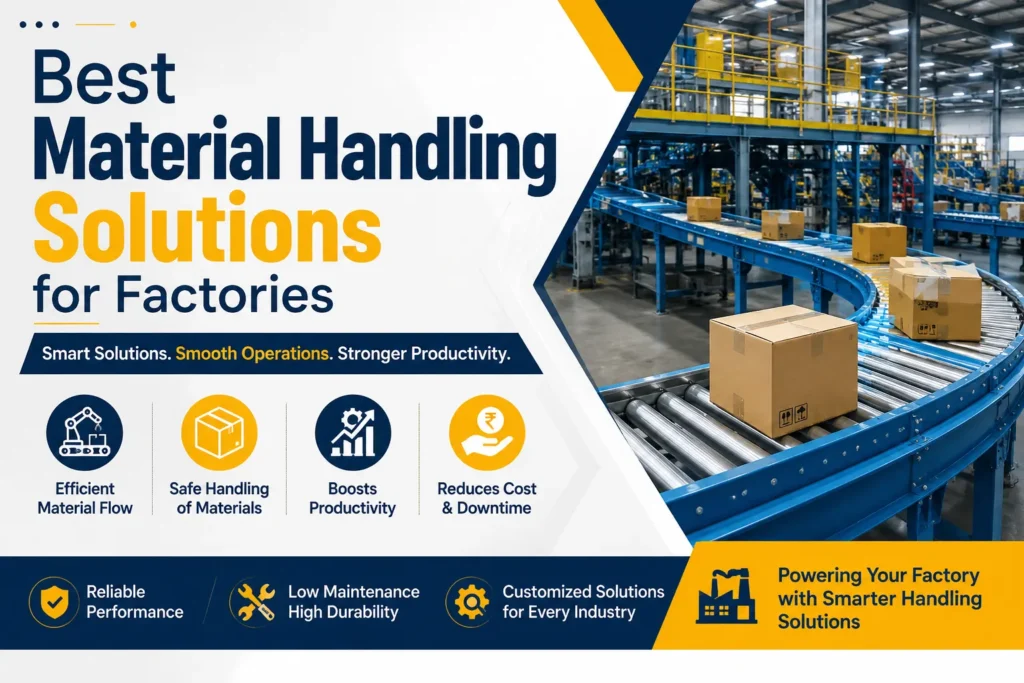
Benefits of Modern Material Handling Systems
Here are some of the benefits in modern automation solutions for material handling in industries-
- Massive reduction in operational costs
- Preventing product damage
- Improved throughput and productivity
- Reduced downtime
- Maximum space utilization with high density racking and automated storage retrieval systems
- Reduced work-related hazards in labors
- Reducing human errors in repetitive tasks
- Increased accuracy and quality control as per industry standards
Types of Material Handling Equipment Used in Factories
If you categorize material handling equipment used in factories they large come in 3 major groups. These are-
Storage and handling equipment: These include pallet racking systems, mezzanines, shelves, bins and drawers
Conveyor systems: These are mostly used for carrying the item as it is processed in stages from a raw material into a finished product
Automated storage and retrieval systems: These are autonomous machines which place and retrieve materials in the warehouse and packaging unit.
Conveyor Systems for Factory Automation
Factory automation today is characterized by extensive use of conveyor systems for ensuring efficient production processes, reduction of manual labor, and continuity in the movement of goods. Today’s conveyor systems are not simply passive transport systems but rather sophisticated systems featuring advanced sensing, barcode scanning, and automatic sorting capabilities.
Roller Conveyor Solutions for Industrial Applications
Roller conveyors are the backbone of industrial material handling, prized for their durability, versatility, and ability to handle heavy loads with minimal energy consumption.
Here are the different roller conveyors used in industries-
- Heavy duty pallet conveyors
- Motorized roller conveyors
- Gravity roller conveyors
Automated Material Handling Systems for Factories
Automated Material Handling Systems (AMHS) act as the nervous system of today’s smart factory. By automating material transport using synchronized and data-driven hardware, AMHS prevents production bottlenecks, avoids damage to products, and maximizes available floor space.
The implementation of an effective AMHS requires the coordination of transportation, storage, and sorting technologies through control software.
Overhead Conveyors for Space Optimization
Overhead conveyors make use of the otherwise unutilized vertical and ceiling space available within the factory to create room on the floor for machinery and workers.
With the materials moving overhead, factories are able to get continuous flow of materials without necessarily increasing their footprint.
Warehouse Material Handling Solutions
Warehouse Material Handling Solutions represent the logistical heart of the supply chain system, dealing primarily with the efficient handling, storing, and protection of products from receiving to shipping. While manufacturing material handling is concerned with coordinating machines, warehouse material handling emphasizes throughput capacity, pick rate, and accuracy.
A modern warehouse depends on an ecosystem of heavy machinery, dynamic robots, and smart software.
Packaging Line Material Handling Systems
Packaging line is the place where the manufactured product moves from being an individual unit to being a protected, serialized, and transportable unit. The Packaging line material handling systems for the packaging line connect production equipment to logistics operations, and they are usually grouped into three levels of packaging: Primary, Secondary, and Tertiary (End-of-Line) packaging.
In order to make sure that the packaging line does not become the ultimate bottleneck of a fast manufacturing plant, material handling needs to be continuous, delicate, and adaptable to various SKUs.
Material Handling Solutions for Manufacturing Plants
Here are some of the material handling solutions for manufacturing industries–
- Intelligent tracking systems
- Modern slat and flexible chain conveyors
- Chain-driver lever rollers
- Autonomous mini-load shuttles
- Automated kitting bins
How Material Handling Improves Factory Productivity
Material handling is now seen as a critical process in manufacturing. As much as 50% of the total space available in the plant is consumed by material handling activities, which consume between 20% and 25% of total manufacturing cost. If you improve this process, you will realize improved productivity, quality, and profitability.
Challenges in Industrial Material Handling Operations
Some of the major challenges in material handling operations are-
- Mismatched machine cycle times
- Islands of automation
- High mechanical wear
- Repeated updates and maintenance in machines
Choosing the Right Material Handling Solution for Your Factory
Selection of the proper Material Handling Solution (MHS) is one of the most important capital expenditure (CapEx) decisions to be made by an engineering or plant management team. The right MHS specification cuts operating costs and increases throughput, whereas the wrong decision creates ongoing problems and mechanical breakdowns.
In order to select the correct MHS for your application, there are four key areas that need to be considered: Load Characteristics, Process Flow, Environment, and Software.
Conclusion: Improving Factory Efficiency with Material Handling Solutions
With factory operations shifting towards higher mix-low volume production and lean manufacturing, the way that materials are transported, buffered, and accounted for sets the maximum capability of the plant.
Using the correct automated material handling system turns a collection of individual machines into an efficient, highly reactive environment.
FAQs About Material Handling Solutions for Factories
Material handling solutions include the equipment, systems, software, and processes used to move, store, protect, track, and control materials and products inside a factory or warehouse. These may include conveyor systems, roller conveyors, storage systems, automated storage and retrieval systems, overhead conveyors, and automated material handling systems.
Efficient material handling helps maintain a smooth flow of raw materials, work-in-progress products, and finished goods. A well-designed system can reduce unnecessary manual movement, improve productivity, support workplace safety, reduce product damage, and help control operating costs.
Common equipment includes roller conveyors, belt conveyors, chain conveyors, overhead conveyors, pallet conveyors, pallet racking, shelving systems, mezzanines, automated storage and retrieval systems (AS/RS), and other automated handling equipment. The right combination depends on the material, load, production process, available space, and required throughput.
Conveyor systems provide a controlled and continuous method of moving materials between different stages of production, assembly, inspection, packaging, and storage. Automated conveyors can also be integrated with sensors, barcode scanning, sorting, and control systems to improve flow and reduce repetitive manual handling.
An Automated Material Handling System (AMHS) uses automated equipment and control software to transport, store, retrieve, sort, or manage materials with limited manual intervention. Depending on the application, an AMHS may combine conveyors, automated storage systems, sensors, scanners, robots, and software for coordinated material movement.
A factory should consider automation when it faces repetitive material movement, production bottlenecks, high manual handling requirements, frequent handling errors, limited floor space, increasing production volumes, or a need for better tracking and consistency. A proper assessment of process flow, load characteristics, environment, throughput, and future production requirements should be completed before selecting a system.
Roller conveyors are commonly used to transport cartons, pallets, containers, and other unit loads through manufacturing and warehouse operations. Gravity roller conveyors are suitable for certain manual-flow applications, while motorized roller conveyors can provide controlled movement. Heavy-duty roller conveyors are designed for heavier loads and demanding industrial environments.
Yes. Overhead conveyor systems use available vertical space to move materials above the factory floor. This can help free valuable floor space for machinery, workers, storage, or other operations while maintaining a continuous flow of materials. The suitability of an overhead conveyor depends on the product dimensions, load, route, production process, and building structure.
The selection should start with a detailed study of the application rather than choosing equipment based only on price. Important factors include load size and weight, material characteristics, required throughput, production cycle time, process layout, available space, operating environment, safety requirements, maintenance needs, and integration with existing automation and software.
Modern material handling automation can improve material flow, reduce repetitive manual work, increase process consistency, minimize product handling damage, improve space utilization, and support higher throughput. When properly designed and integrated with the production process, it can also help reduce bottlenecks and provide better visibility into material movement.
