
Low Level Palletizing Machine Manufacturers in India
Our low-level palletizers receive products at floor level, building and forming layers with precision.
Low Level Palletizing Machine
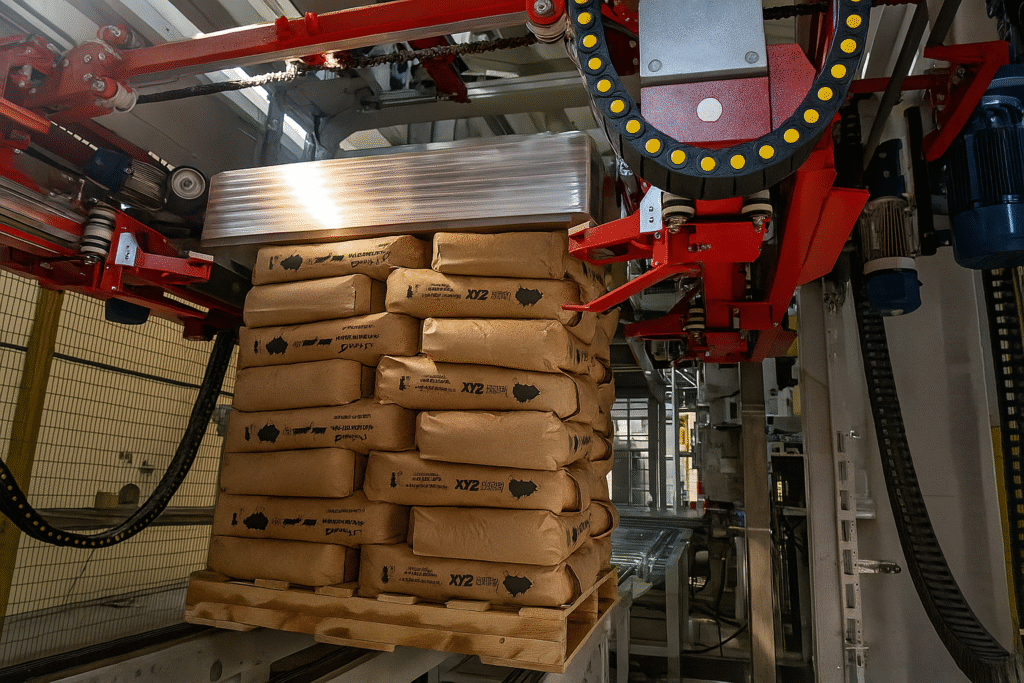
ETI Solutions excels in Low-Level Palletizing. In our system, products on the infeed conveyor are precisely rotated for correct orientation before indexing to the row formation area. Completed rows are then pushed onto a dedicated layer-forming area, which may be a table or stripper plate, depending on the machine’s design.
The fully formed layer advances onto a transfer plate, which then accurately lowers or raises to align with the stationary pallet or the previous layer. This process repeats with precision until the palletization is complete. Finished pallets are then smoothly transferred to the elevated pallet discharge conveyor.
From there, the palletized load is transported to storage or a stretch wrapper. The cycle completes and resets as soon as the finished pallet is removed, ensuring continuous, efficient operation.
Type
1 in/1 out
Payload
5Kg – 200Kg
Speed
10-20 cases/min, bags – 20 bags/min
Layout type
Customizable (with limitations)
Product size range
100mm – 600mm L
100mm – 600mm W
50mm – 400mm H
Product to be handled
Bags, cases, shrink packs, etc.
- Costs less because it doesn't need a work platform
- Easy to reach parts make maintenance straightforward
- Fork truck operators can keep an eye on case infeed while handling pallets
- Perfect for working closely with case packers and sealers that are at the same height
- Low-level palletizers use less space, ideal for smaller facilities
- Their compact shape fits well in different production spaces
- Simple to install, which means less downtime getting started
- Easy access reduces the need for lots of material handling equipment, making operations smoother
- Can handle various product sizes, making it versatile for different loads
Get a Quote
Get a free quote for your conveyor system.
Need more help?
Contact our expert team for custom conveyor solutions and dedicated support for your project
+91 98210 51034
Testimonials
Proven Client Success
Discover why leading companies trust ETI Automation for their most complex automation projects.




Common Questions
Most Popular Questions.
Your questions, answered. Browse our FAQs for help with our conveyor systems and automation solutions.
A low-level palletizing system automatically stacks products on pallets from a low-height infeed conveyor.
It can handle cartons, boxes, bags, crates, shrink-wrapped packs, and other packaged products.
It improves stacking speed, reduces manual labor, increases accuracy, and lowers product damage.
Yes. It can be designed to match your product size, pallet pattern, and production line.
They are widely used in food, beverage, pharmaceutical, chemical, FMCG, and manufacturing industries.
ETI Automation provides reliable, customized palletizing systems with complete design, installation, and support.